




EVERY PRIDE FLAG EXPLAINED: WHAT THEY MEAN & WHY THEY MATTER

Did you know there are over 30 widely recognised Pride flags in active use today?!
Each one stitched from history, identity, and a healthy dose of rebellion (Pride is a protest, after all), each one equally important.
If you’ve ever been curious about what each flag represents, this blog post is for you.
Here is your Spark no-nonsense guide to the Pride flags you're most likely to spot at UK Pride events this summer.
We’ll cover what they look like, what the colours mean, who designed them, and why they exist.
The one everyone knows: The Rainbow Flag
Designed by: Gilbert Baker, 1978
Colours: Red, orange, yellow, green, blue, violet
Gilbert Baker was a drag performer, a Vietnam War veteran, and the person Harvey Milk asked to design a symbol for San Francisco's gay community.
The original had eight stripes: hot pink for sex, red for life, orange for healing, yellow for sunlight, green for nature, turquoise for art, indigo for harmony, violet for spirit.
Manufacturing limitations chopped hot pink and turquoise, leaving the six-stripe version that became the most recognised LGBTQ+ symbol on the planet.
Side note: Baker did not invent the rainbow as a symbol; he took something general and made it ours. That distinction matters.
👉 Shop our Rainbow tee
The current standard: The Intersex-Inclusive Progress Pride Flag
Designed by: Valentino Vecchietti, 2021
Added elements: Black and brown stripes, trans flag colours (pink, white, blue), and a yellow triangle with a purple circle for intersex representation

Spotted a rainbow flag recently with a chevron of extra colours on the left? This is the one.
It now sits proudly in the Smithsonian's Cooper Hewitt collection, which tells you everything you need to know about how significant it has become.
The evolution went like this: Philadelphia added black and brown stripes in 2017 to represent queer people of colour. Daniel Quasar added the trans flag colours in a chevron shape in 2018. Vecchietti, who is intersex, added the yellow triangle with purple circle in 2021.
The arrow shape is deliberate; it points forward.
Progress is still being made, and the flag knows it.
As of 2026, this is the most up-to-date version of the umbrella LGBTQ+ flag, and the one you'll see flying hardest at UK Pride events this summer.
👉 Shop our The First Pride Was A Riot tee
Transgender Pride Flag
Designed by: Monica Helms, 1999
Colours: Light blue, pink, white, pink, light blue

This flag matters enormously right now. Trans rights are under sustained attack in the UK and globally, and flying or wearing this flag is an act of solidarity as much as it is an act of pride.
The light blue stripes represent boys, the pink stripes represent girls, and the white stripe in the middle represents those who are transitioning, non-binary, or consider themselves to have a neutral or undefined gender.
Helms designed it to be reversible so no matter which way you fly it, it is always correct.
She said this was intentional: “We're always moving forward.”
👉 Shop our Trans Rights Are Human Rights tee
Bisexual Pride Flag
Designed by: Michael Page, 1998
Colours: Pink, purple, blue

Page designed it specifically to boost bisexual visibility, both in wider society and within the LGBTQ+ community itself.
Pink represents attraction to the same sex, blue represents attraction to the opposite sex and purple in the middle, created by the overlap of pink and blue, represents attraction to two or more genders.
Bi people cop erasure from all directions. Often told they're “really straight” when in opposite-sex relationships or told they're “really gay” when in same-sex ones.
This flag is a proud reminder that bisexual people exist and they deserve recognition within the community.
👉 Shop our Bisexual Hearts tee
Pansexual Pride Flag
Designed by: Community-created, ~2010
Colours: Pink, yellow, blue

Pansexuality is a romantic, sexual, or emotional attraction to people regardless of their gender, and this flag is the symbol.
Pink represents attraction to women, blue represents attraction to men, yellow represents attraction to non-binary and gender non-conforming people.
The key distinction from the bisexual flag is that pansexuality is often described as attraction regardless of gender, rather than attraction to two or more genders.
In practice, loads of people use both terms, or sit comfortably with either. The flags overlap. The identities overlap. That is not a contradiction; it's just the beauty of how humans work and we LOVE it.
👉 Shop our Pansexual Flag tee
Lesbian Pride Flag
Designed by: Emily Gwen, 2018
Colours: Dark orange, orange, light orange, white, pink, dusty pink, dark rose

This one has receipts… An earlier “lipstick lesbian” flag existed but fell out of favour once its creator was found to hold transphobic and biphobic views (gross).
The community rallied and Emily Gwen's redesign was created; deliberately inclusive of all lesbians, and has since found itself as the widely accepted version.
The various shades represent different aspects of lesbian identity: gender non-conformity, independence, community, unique relationships to womanhood, serenity, love, femininity.
You'll most often see the simplified five-stripe version flying.
👉 Shop our Lesbian Flag tee
Non-Binary Pride Flag
Designed by: Kye Rowan, 2014
Colours: Yellow, white, purple, black

The non-binary flag was created specifically because the existing genderqueer flag did not feel representative to everyone outside the binary (totally valid!)
Yellow represents those whose gender exists outside the binary, white represents those with many or all genders, purple represents those who feel their gender is a mix of male and female, and black represents those who feel they are without gender.
👉 Shop our Girls, Gays, Theys tee
Asexual Pride Flag
Designed by: Asexual Visibility and Education Network (AVEN) community, 2010
Colours: Black, grey, white, purple

Asexuality is one of the most misunderstood orientations going, often dismissed as “not a thing,” or muddled up with celibacy.
You don’t need us to tell you that it's very much a thing.
Black represents asexuality, grey represents the grey area between asexual and sexual (sometimes called grey-asexual or demisexual), white represents sexuality and purple represents community.
👉 Shop our Asexual Flag tee
Aromantic Pride Flag
Designed by: Cameron (@cameronwhimsy on Tumblr), 2014
Colours: Green, light green, white, grey, black

Aromantic people experience little or no romantic attraction (that's separate from sexual attraction). An aromantic person can be asexual, bisexual, gay, straight, or any other orientation. The flag makes that distinction visible.
Green represents aromanticism, light green represents the aromantic spectrum, white represents platonic and aesthetic attraction, grey represents grey-aromantic and demiromantic people and black represents the sexuality spectrum.
Intersex Flag
Designed by: Morgan Carpenter, 2013
Colours: Yellow background with a purple circle

Carpenter deliberately chose yellow and purple because they sit outside the gendered associations of pink and blue.
The unbroken circle represents wholeness, completeness, and the right to bodily autonomy.
Intersex people, those born with sex characteristics that don't fit typical definitions of male or female, have historically faced medically unnecessary surgeries in infancy; this flag is as much about bodily autonomy as it is about identity.
Genderfluid Pride Flag
Designed by: JJ Poole, 2012
Colours: Pink, white, purple, black, blue

Genderfluid people experience their gender as changing over time, sometimes more masculine, sometimes more feminine, and sometimes neither.
Pink represents femininity, white represents lack of gender, purple represents a combination of masculinity and femininity, black represents all genders and blue represents masculinity.
The range of colours reflects that fluidity.
👉 Shop our Gender: What A Drag tee
Why Pride flags matter
We get it; that's a lot of flags.
But here is what Monica Helms (yes, the same one who designed the trans flag) said about it:
“The rainbow flag is like a national flag: everyone's underneath it. But each community, like each state, has its own.”
Flags are shorthand. They say “I'm here, I belong, this is me” without requiring a coming out speech, a justification, or a TED talk.
For communities that have spent decades being told to keep it down, that bit of visual shorthand is a form of freedom.
You don't have to memorise every flag (there is no test at the door) but knowing what they mean, and knowing that they matter to the people flying them, is a solid place to start.
Wear your flag
If you want to wear your Pride this summer at a parade, at work, or on a regular Tuesday because you feel like it, our LGBTQ+ Pride collection has tees, hoodies, and accessories built to say exactly what you mean.
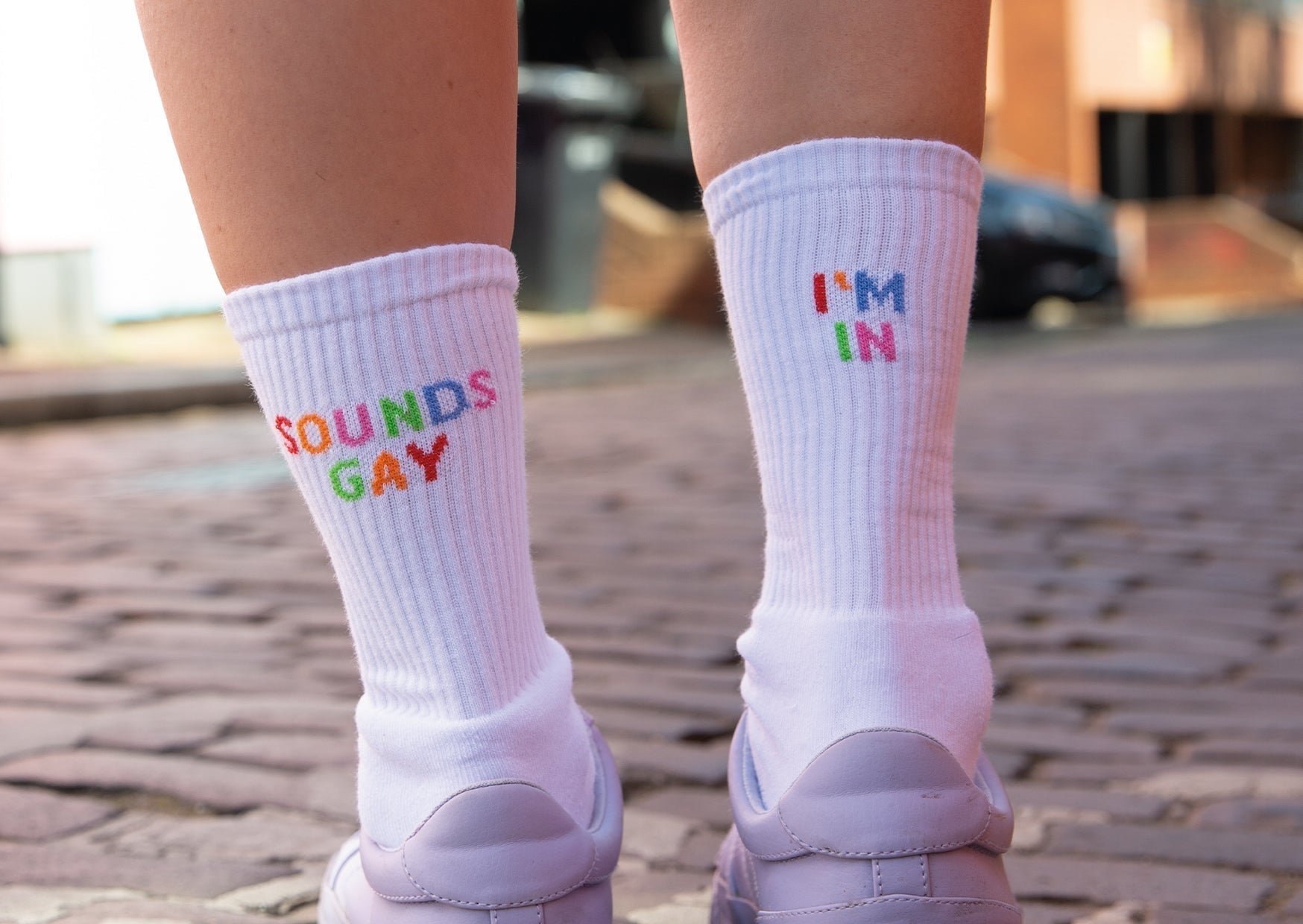
From the Rainbow Heart tee to Sounds Gay I'm In to Trans Rights Are Human Rights, every design is ethically produced, and donates to charity with every order.
Wear your flag like you mean it. We do. 🏳️🌈
👉 Shop LGBTQ+ Pride Clothing
,%20each%20o...)
Leave a comment
This site is protected by hCaptcha and the hCaptcha Privacy Policy and Terms of Service apply.